Documents
The Assessment Process — What to Expect
U Maganlal Psychology Inc. · Urvashi Maganlal — Clinical Neuropsychologist / Clinical Psychologist
A neuropsychological assessment should not be thought of as a stand-alone “test” — something one passes or fails in a single sitting. It is better understood as a process: a careful, collaborative journey that unfolds over several steps, each one informing the next. It is also important to note that the outcomes of a neuropsychological assessment are not set in stone, and that these results inform what happens next. These results are glimpses of a much bigger picture.
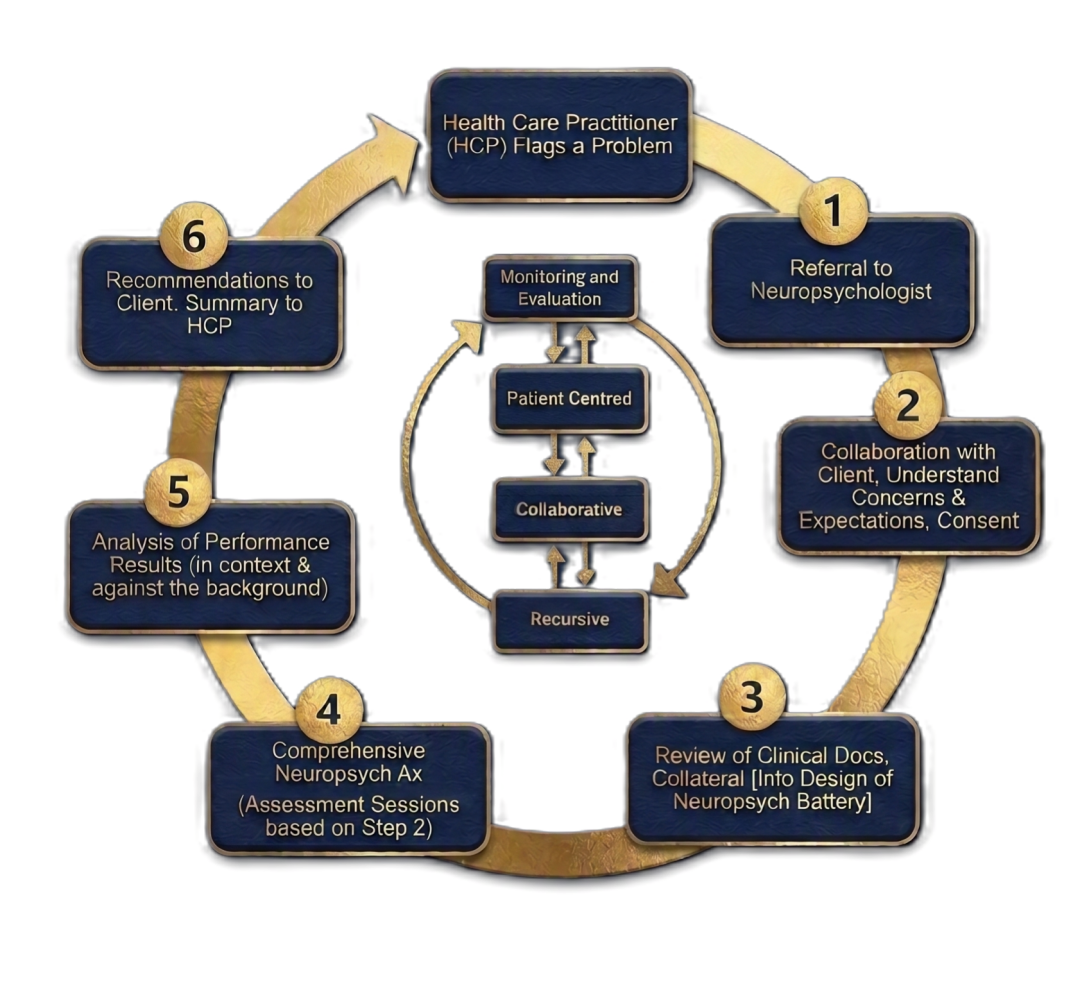
It begins when a health care practitioner notices a concern and refers you. From there, we work together to understand your concerns and expectations, and to obtain your consent. Relevant clinical documents and collateral information are reviewed, and an assessment battery is designed around your particular situation. The assessment itself takes place over one or more sessions, after which performance is analysed in context — against your history and circumstances, never a number in isolation. Recommendations are then shared with you, and a summary is provided to the referring practitioner.
Throughout, the process stays patient-centred, collaborative, and recursive, with ongoing monitoring and evaluation — so that what is learned at each step shapes the next. The diagram below sets out this cycle.
Fees & Procedure Codes
Session rates depend on your medical aid; otherwise a private rate will apply. Please note that fees are also dependent upon the diagnosis, and subject to funds being available:
-
1
Initial consultation
-
2
Assessment consultation
-
3
Additional session (if needed)
Budget for it — but if it is not needed, I will not unnecessarily book this. The aim is not to over-test.
-
4
Feedback session
This can also be given to the family, via Zoom, MS Teams or Google. If multiple sessions are needed, these are charged per session.
-
5
Summary of findings
A summary of findings with recommendations (should this be requested) is charged at an additional cost — payable by EFT or credit card on the day of the feedback. The findings are also sent to the referral source. Some medical aids may refund a very small portion of this fee.